Doris Maase, née Franck
Born on March 4, 1911, in Briesen, Brandenburg – died on September 20, 1979, in Dorfen, Bavaria
Doctor
Lichtenburg women's concentration camp, then Ravensbrück: May 1939 – June 1941
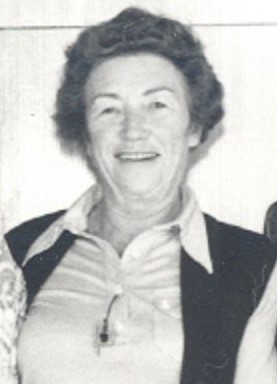
Doris Maase, 1974, Fotoalbum Rosa Jochmann, DÖW Wien
Born in Briesen (Brandenburg) on 4 March 1911, Doris Maase began studying medicine in 1929. At the University of Berlin she became involved with the “Red Student Group” and in 1933 she was expelled from the university. She then continued her studies in Basel and completed them with a doctorate in 1934. In the same year she married Klaus Maase, an engineer. Together they moved to Düsseldorf.
Because of their support for the illegal Communist Party of Germany (KPD), Klaus and Doris Maase were arrested in 1935, and in September 1936 Doris was sentenced to three years in the Ziegenhain penitentiary.
After serving her sentence, Doris Maase was not released but placed in so-called “protective custody” in the women’s concentration camp Lichtenburg. Initially classified as a prisoner nurse and from 1939 as a prisoner physician, she helped many prisoners with medical certificates and medication. After the closure of Lichtenburg concentration camp in May 1939, she was transferred—like many other women from that camp—to Ravensbrück. There too she worked as a prisoner physician until her release from the camp in June 1941.
She was later honored by** Rosa Jochmann**, a member of the Austrian Social Democratic Party (SPÖ) and also a prisoner in Ravensbrück since 1940, who praised her commitment to the sick and called her the “guardian angel of the camp.”
The daughter of a Jewish doctor and his “Aryan” wife owed her release from the camp to her mother. An old friend, married to an SS officer from Himmler’s staff, owed her a favor and secured her release through her contacts. Back in freedom—though required to report regularly to the authorities—she worked as a medical assistant in a practice. Klaus Maase, by contrast, was not liberated until 1945. In Buchenwald the SS had offered him release if he would divorce his “half-Jewish” wife. He refused, out of love and because it was feared that she would otherwise be arrested again and deported to Auschwitz.
After liberation in 1945 she opened her own medical practice in Düsseldorf. She was among the Ravensbrück prisoners whose testimonies contributed to the conviction of leading SS officials responsible for the Ravensbrück concentration camp. She also helped other concentration camp survivors by providing medically substantiated expert reports required for compensation claims. In the mid-1960s she had to give up her medical practice due to poor health.
Like all her comrades from the Federal Republic of Germany, Doris Maase had to witness the amnesty granted to former members and officials of the National Socialist regime and their reintegration into all areas of the state and society. At the same time, she experienced how the Federal Republic, immediately after its founding, anchored anti-communism politically and legally, and how almost all media quickly followed this course.
Despite her professional work and family responsibilities with two children (born in 1946 and 1948), Doris Maase continued to work for peace and democracy. From 1948 to 1956 she was a city councillor for the KPD and worked especially on behalf of the poorer residents of the city. She was also chairwoman of the “Working Group of Democratic Women” in Düsseldorf and a member of the Association of Victims of the Nazi Regime (VVN).
After the ban of the KPD in August 1956, she ran as a non-party independent candidate for the North Rhine-Westphalia state parliament. As a result, she was sentenced to five years’ imprisonment on probation for activities interpreted as continuing the political goals of the banned KPD.
This also affected her personal circumstances. Compensation payments that had been granted (already modest) for the years of imprisonment and the health damage she suffered were reclaimed because of her engagement with the KPD and later due to alleged anti-democratic actions directed against democracy under the Federal Compensation Act (BEG).
Her appeals against the corresponding administrative decisions and subsequent lawsuits were repeatedly rejected. Doris Maase fought back in court. The legal proceedings lasted for decades, into the late 1970s.
Maintaining solidarity among survivors and preserving the memory of the dead of Ravensbrück were central parts of her life. On the occasion of the inauguration of the Ravensbrück Memorial in autumn 1959, Doris Maase and Luise Mauer published a call to participate in the commemorations. In 1966 she was among the founding members of the “Ravensbrück Camp Working Group” in the Federal Republic of Germany. Later she served as its chairwoman and represented former Ravensbrück prisoners from West Germany in the International Ravensbrück Committee.
Doris Maase died on 20 September 1979. She did not live to see the final and favorable outcome of the legal disputes.
(Henning Fischer „Überlebende und Akteurinnen. Die Frauen der Lagergemeinschaften Ravensbrück: Biographische Erfahrung und politisches Handeln, 1945 bis 1989; UVK Verlagsgesellschaft mbH, Konstanz, ISBN 978-3-86764-772-4)