Now Jewish women in concentration camps are also being commemorated.
05.03.2026
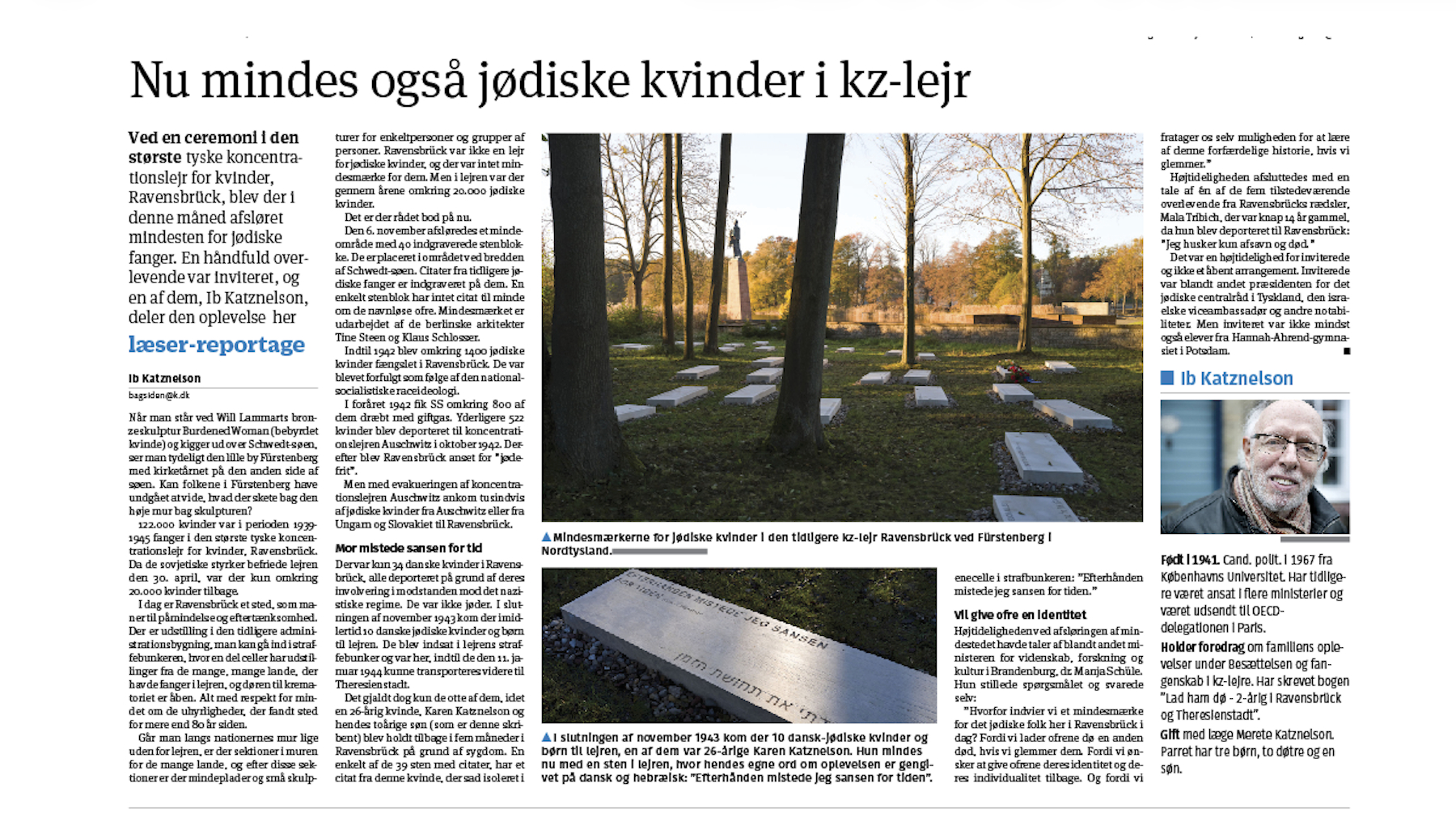
Standing next to Will Lammert’s bronze sculpture “Die Tragende” and looking across the Schwedt Lake, one can clearly see the small town of Fürstenberg with its church tower on the other side of the lake. Could the residents of Fürstenberg ignore the truth about what was happening behind the high wall behind the sculpture?
Between 1939 and 1945, 122,000 women were imprisoned in Ravensbrück, the largest German women’s concentration camp. When Soviet troops liberated the camp on 1 April 1945, only about 20,000 women remained.
Today, Ravensbrück is a place of remembrance and reflection. The former administration building hosts an exhibition, visitors can tour the cell block where some cells display exhibits from the many countries that once interned prisoners in the camp, and the door to the crematorium stands open. All of this is done in honored memory of the atrocities that occurred over 80 years ago.
Along the Wall of Nations directly in front of the Ravensbrück camp are sections dedicated to different countries. Behind these gentle colors lie commemorative plaques and small sculptures for individuals and groups. Ravensbrück was not originally a camp for Jewish women, and for a long time there was no memorial for them. Yet over the years, around 20,000 Jewish women were imprisoned in the camp.
This has now been corrected.
On 6 November, a memorial site with 40 engraved stone blocks was unveiled. It is located on the banks of the Schwedt-Spen. The blocks feature quotes from former Jewish prisoners. One stone block bears no quote, in memory of the nameless victims. The memorial was designed by Berlin architects Tine Steen and Klaus Schlosser.
By 1942, about 1,400 Jewish women were imprisoned at Ravensbrück. They were persecuted under the National Socialist racial ideology.
In the spring of 1942, the SS murdered around 800 of them with poison gas. Another 522 women were deported to Auschwitz concentration camp in October 1942. After that, Ravensbrück was considered “Judenfrei” (free of Jews).
However, with the evacuation of Auschwitz, thousands of Jewish women from Auschwitz, Hungary, and Slovakia were sent to Ravensbrück.
Mother lost her sense of time.
At Ravensbrück, there were only 34 Danish women, all deported for their involvement in resistance against the Nazi regime. They were not Jewish. At the end of November 1943, however, 10 Danish Jewish women arrived at the camp. They were placed in the camp’s punishment cells and remained there until 11 January 1944, when they could be transported to Theresienstadt.
This applied to only eight of them, because one 26-year-old woman, Karen Katznelson, and her second son (the author of this text) were held in Ravensbrück for five months due to illness. One of the 39 memorial stones bears a quote from this woman, who was held in solitary confinement in Ravensbrück. Solitary in the punishment block:
“Gradually… I lost all sense of time.”
Giving the victims an identity
At the unveiling ceremony of the memorial, among the speakers was Dr. Manja Schüle, Brandenburg’s Minister for Science, Research, and Culture. She asked the question and answered it herself:
“Why do we inaugurate a memorial for the Jewish victims here in Ravensbrück today? Because we let the victims die a second time if we forget them. Because we want to restore their identity and individuality. And because we rob ourselves of the chance to learn from this terrible history if we forget it.”
The ceremony ended with a speech by Mala Tribich, one of the five survivors of Ravensbrück. She was barely 14 years old when deported there:
“I remember only deprivation and death.”
The ceremony was for invited guests only and was not a public event. Invited were, among others, the president of the Central Council of Jews in Germany, the Israeli deputy ambassador, and other dignitaries. Also invited were students from the Hannah-Arendt-Gymnasium.